
I’ve been doing this job for the best part of ten years, and if there’s one thing I can tell you with total confidence, it’s this: cats do not care about your carpet. Not one bit. They will shed on it, scratch at it, sit in judgement of it, and somehow still make it look like your fault.
I’ve walked into more front rooms than I can count where the owner apologises for “letting the place go,” when really, the carpet’s fine. It’s just wearing a very convincing coat of cat.
So when a client calls the office and says “it’s just a quick freshen up before we go away,” I’ve learned to read between the lines. Nine times out of ten, there’s a cat involved.
Quick answer: if your carpet’s covered in embedded cat hair, a vacuum on its own won’t shift it. You need something with a bit of grip. A rubber tool works brilliantly, used while the carpet’s slightly damp, followed by a proper clean if the hair’s worked deep into the pile. Let me walk you through exactly how, using a job we did in Haverhill not long ago.
Why Cat Hair Digs In Instead of Sitting on Top
Here's the bit most people don't realise. Dust sits on your carpet. Cat hair burrows into it.
Cats spend around a tenth of their day grooming themselves, which sounds almost admirable until you remember where all that loose fur ends up. And if your cat's an indoor one, it doesn't even have the decency to shed seasonally. It just keeps going, quietly, all year round.
That constant, low-level shedding is exactly why cat hair works its way down between carpet fibres rather than staying on the surface where your vacuum can get at it. It's not that your hoover is rubbish. It's that the hair's hiding somewhere it can't reach.
Think of it like sand in a beach towel. The bit on top brushes off easily. The bit worked into the weave takes a proper shake before it gives up.
What Actually Works (And What's a Waste of Your Sunday)
Over the years I've watched clients try everything short of an exorcism to get cat hair out of a carpet. Some of it works. Some of it just makes a mess.
A rubber glove or a rubber-edged squeegee, dragged firmly across the carpet, is genuinely one of the best tricks going. The static pulls the hair up and it balls together nicely. Do it while the carpet's slightly damp and it works even better, which is exactly the trick we used on the job I'll tell you about shortly.
Lint rollers are fine for a rug or a stair tread. Less fine for a whole living room, unless you enjoy repetitive strain injury. Baking soda sprinkled beforehand can help loosen things up before you vacuum, and a proper pet-hair vacuum attachment earns its keep too.
One thing I'd steer you away from: fabric softener sprayed onto carpet as a quick fix. I get the logic, it's meant to cut down static, but I've seen it leave a residue that actually attracts more dirt over time. Good intentions, poor outcome.
I once had a client tell me she'd tried “everything,” including a leaf blower on the stairs. Points for creativity. It did not work.
If it's dog hair and that particular dog smell you're dealing with rather than a cat, we've covered that separately .
The Job That Changed a Hallway (and Nearly Fooled Everyone)
Let me tell you about a job we did for a lovely, long-standing client near Sturmer, just outside Haverhill. She'd booked us in before a holiday, mainly so the house looked and smelled right for the cat-sitter staying over while she was away.
Our technician who'd quoted the job had noted “heavy traffic lane soiling” in the hallway and bedroom, the kind of wear you'd expect where people walk most. A fair assumption. The wrong one, as it turned out.
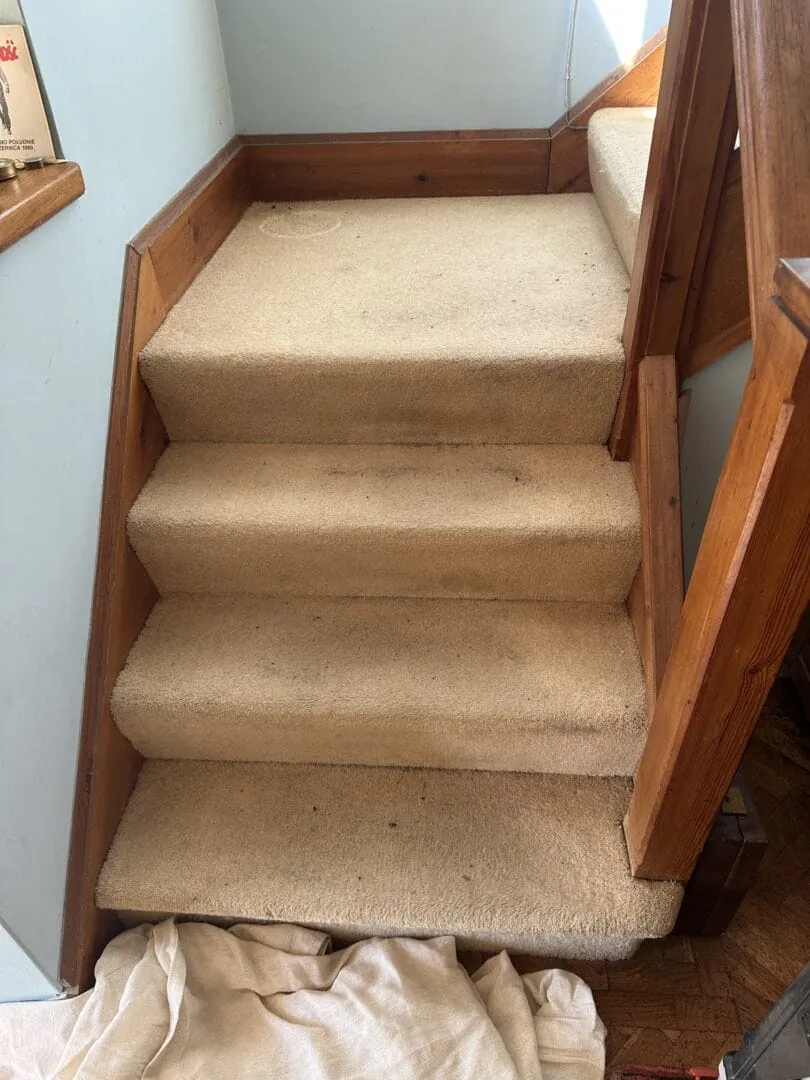
When our cleaner arrived and got down to it, he realised the soiling wasn't foot traffic at all. It was cat hair. An enormous amount of it, sitting right on the surface of the carpet, doing a very convincing impression of general grime.
He vacuumed thoroughly first, then used a rubber-tipped tool to lift out what the vacuum had missed. That's when things got interesting. Once the pre-spray went on and the carpet was agitated and cleaned, a cream wool carpet appeared from underneath. Genuinely appeared, like it had been hiding there the whole time. He told me afterwards it was like watching feline fuzz peel back to reveal a completely different floor.
As the carpet stayed damp during the clean, even more hair started showing up. Dampness seems to make the fibres easier for the rubber tool to catch, so he went over it again with the same trick, right through onto the stairs.
When the client and her husband came to see the finished job, they were genuinely stunned. She hadn't expected the carpet underneath to look that good. That's one of my favourite parts of this trade, if I'm honest: the moment someone sees their own home properly for the first time in years.
When It's Time to Call in a Professional
DIY methods have their place, and I'd never talk anyone out of trying the rubber-glove trick first. But there are a few signs it's time to bring in someone who does this for a living.
If hair keeps reappearing after several vacuum passes, if there's a musty smell that won't shift, or if what looks like general soiling doesn't improve with normal cleaning, it's worth getting a second opinion. That last one, funnily enough, is exactly what caught our technician out in Haverhill. Sometimes what looks like one problem is actually another one entirely, and it takes an experienced eye to tell the difference.
I've seen carpets written off as “past saving” when they just needed the right treatment, and I've seen money spent trying to rescue a carpet that had genuinely reached the end of the road. Being honest about which situation you're actually in protects your investment either way. That's the bit I care about most.
What We Actually Do
There's no secret formula here, just our carpet cleaning process , done properly. We inspect the carpet and the fibre type first, because wool and synthetic pile don't always respond the same way. Then it's a pre-spray, agitation with proper equipment, a rubber tool for any embedded hair, hot water extraction, and a final groom so the pile sits right as it dries.
It's not glamorous. It works.
I trained through the IICRC early in my career, and it's a standard I still hold the whole team to. Techniques move on, and what counted as best practice ten years ago isn't always best practice now. We treat ongoing training as part of the job, not an optional extra.
Does Cleaning the Carpet Actually Help With Allergies?
Fair question, and one I get asked a lot. There's research from the Carpet and Rug Institute, working with an independent research group, that found properly cleaned carpet (vacuumed, treated, agitated and extracted with hot water) significantly reduced airborne cat allergen levels compared with carpet left uncleaned. As the physician overseeing that study put it, effectively cleaned carpets can actually trap allergen particles rather than let them float around your home.
Worth knowing too: every cat produces the allergen behind most reactions, regardless of breed or coat length. There's no such thing as a truly hypoallergenic cat, however much certain breeders might tell you otherwise. Regular, proper cleaning is genuinely one of the better tools you've got, especially in a house with young kids, older relatives, or anyone who gets a bit wheezy in spring.
None of this is medical advice. But it's reassuring to know that keeping on top of your carpets isn't just about how the place looks. It does a quiet job in the background too.
Why This Matters to Us
This is exactly the kind of work Art of Clean was built around. Not just getting a carpet looking presentable for an afternoon, but understanding what's actually happening in the fibres, and being honest with you about what will and won't come out. Whether it's cat hair, old stains, or a carpet that's simply had enough, we'd rather tell you the truth and do the job properly than take a shortcut.
That's been the standard since day one, on every job we take on. It's the reason clients keep calling us back, cat-sitter or not. There's something genuinely satisfying about pulling a good carpet out from under a decade of cat fluff, and watching someone realise it was there all along.
If your own carpets could use the same treatment, get in touch , and we'll take a look.