
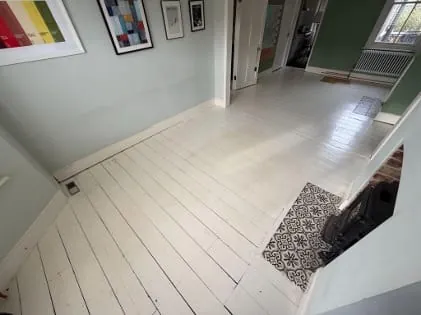
There’s something about a Victorian pine floor that’s hard to replace. The character. The warmth. The story in every board.
But when it’s been painted over, especially in white, it raises a fair question.
What’s actually underneath?
That’s exactly where this Cambridge project began.
Project Overview: A Painted Floor with Potential
This was a repeat client. She had just bought a property in Cambridge and wanted to bring the original Victorian boards back to life.
The floor had been completely painted white.
Now, people rarely paint a floor without a reason. It is often done to hide something such as stains, damage, or mismatched repairs.
So before any sanding began, the real question was simple.
Are we restoring something beautiful, or uncovering a problem?
The Client’s Concerns and Why They Were Valid
She wanted the original look back. That part was clear.
But she also understood the risks.
What if the paint was hiding deep stains?
What if parts of the floor could not be sanded back properly?
What if previous repairs had left boards that would never match?
These concerns were not unusual.
We have seen floors where pet stains had soaked deep into the timber. No amount of sanding fixes that. We have also seen boards replaced after water damage that never blend in again.
So the honest answer at the start was straightforward. We do not know yet. But we will find out properly.
Common Risks with Painted Victorian Floors Risk Can It Be Fixed? Notes Pet stains Sometimes Can penetrate deep into the wood Water damage Partially May require board replacement Thick paint layers Yes Needs careful sanding Mixed boards Depends May need reclaimed timber
Paint often hides more than just colour. It hides history.
Why Painted Floors Can Be a Gamble
Paint can cover up years of wear and tear.
It can hide:
Deep staining
Poor repairs
Mixed timber from different periods
Structural wear
Victorian pine is a softer wood. It shows its age more than modern materials.
That is part of its charm. But it also means you need to approach restoration with care and a bit of realism.
Our Approach: Start with a Test Patch
We did not rush into sanding the entire floor. Instead, we carried out a test patch. This allows us to see what is happening beneath the surface without committing the client to a full job.
Why a test patch matters
Identifies hidden damage
Reveals stains and inconsistencies
Highlights replaced boards
Helps avoid unexpected costs
What we found
As expected, some boards were newer pine. These had likely been installed after water damage. New pine behaves differently to old boards. Even after sanding, it can stand out.
We explained the options clearly.
Keep the boards and accept variation
Replace them with reclaimed timber
We also made it clear that we could not confirm the full scope until the entire floor was sanded.
No guesswork. No overpromising.
The Restoration Process Done Properly
Restoring a Victorian pine floor is not about rushing. It is about doing
each step correctly.
Step 1: Preparation
We removed surface coatings and checked for loose or damaged boards.
Good preparation sets the foundation for everything else.
Step 2: Sanding Back the Paint
We used a progressive sanding process, starting with coarse grit and working towards a finer finish.
This removes the paint without damaging the wood underneath.
Sanding only removes a very thin layer of the surface, preserving the structure of the boards while restoring their appearance.
Step 3: Full Assessment
Once the paint was removed, we could properly assess the floor.
The result was better than expected.
Most of the original boards were in excellent condition.
Only eight boards needed replacing.
Step 4: Board Replacement
Where replacement was needed, we used reclaimed pine. Finish Best For Look Durability Oil Natural style homes Warm and soft Medium Lacquer Busy households Clean and modern High Stain Colour adjustment Customised Varies
Reclaimed boards help maintain the natural look of the floor.
Step 5: Finishing Options
We always let the client see options in their own space.
We applied sample finishes so she could choose what suited her home best.
Oil is a great choice for natural style homes, offering a warm and soft look with medium durability. Lacquer works well in busy households, giving a clean and modern finish with high durability. Stain is ideal if you want to adjust the colour, providing a customised look with durability that can vary depending on the product used.
Choosing the right finish is about balancing appearance and long term care.
The Result: A Floor Worth Saving
Once complete, the difference was clear.
The paint was fully removed from the surface
The natural grain was visible again
The character of the boards was restored
You could still see nail holes and old woodworm markings.
That is exactly how it should be.
Those details are part of the story, not defects.
Key Results
Boards replaced: 8
Original boards retained: over 90 percent
Paint removed: fully from surface
What the Client Said
Sian was delighted with the outcome and took the time to leave a detailed Google review after the work was completed.
She highlighted the experience from start to finish, particularly the honest assessment at the beginning and the clarity around what could realistically be achieved.
In her words:
“Excellent and professional service from the first assessment and realistic information of what could be done to restore this old Edwardian terrace. The staff are extremely knowledgeable, polite and efficient, and did a beautiful job. I have used Art of Clean previously and will continue to recommend them for this type of work.”
She also shared her own photo of the finished floor, which speaks for itself.
For us, that kind of feedback matters. It reflects not just the final result, but the process, the communication, and the trust built along the way.
Restoration vs Replacement
Many clients ask whether it is better to restore a wooden floor or replace it entirely. The right answer depends on the condition of the floor, the type of timber, the level of damage and the finish you want.
In many suitable cases, restoration is the better route because it keeps the original floor, reduces waste and protects the character of the room.
Art of Clean wood floor restoration prices Finish option Price per m² Essential Lacquer £70 Standard Lacquer £85 Premium Lacquer £95 Oil £75
Why restoration can make sense
Restoration may be a better option when the existing timber is sound enough to work with. It can help preserve the age, grain and character of the floor while avoiding the waste and disruption of removing and replacing it.
Original Victorian pine, older boards and established timber floors often have a feel that new wood cannot fully replicate. The right finish also matters. Some homes suit the practical protection of lacquer, while others suit the look and feel of oil.
Before recommending a finish, the floor should be assessed so the advice matches the timber, the condition and how the room is used.
Common Mistakes to Avoid
✔ Attempting DIY sanding without experience
✔ Using the wrong finishes or fillers
✔ Expecting a perfect, uniform look
Victorian floors are not meant to look brand new. They are meant to look right.
Is Your Floor Worth Restoring?
Use this quick checklist.
Painted wooden floor
Original boards still present
Structurally sound base
Signs of wear but not severe damage
If you can tick two or more, it is worth getting a professional assessment.
A Floor Worth Keeping
This Cambridge project shows what can happen when the right approach is taken.
No rushing. No assumptions. No shortcuts.
Just a clear process, honest advice, and careful workmanship.
At Art of Clean, the focus is not just on sanding a floor. It is about helping clients make the right decisions and protecting their investment for the long term.
When done properly, a Victorian pine floor does not just look better.
It lasts.